System design · Behavioural economics
C’Sights
Cities spend hundreds of millions on tourism. Why are the shops inside those cities dying?
- Role
- System design · hypothesis · validation design
- Period
- 2025
The same fact, seen from the wrong angle
Cities spend enormous tourism budgets. The cafes, markets and small shops inside those cities are dying. The two look like opposites. They are not — they are the same fact.
The angle is the KPI. Cities measure tourism by visitor count. A tour bus unloading a hundred people for ten minutes of selfies scores the same as a hundred people who stay three hours and spend money. The metric calls them identical; the economy calls them opposite. Visitor-count is a vanity metric. The real one is visitor-hours.
A couple exploring a local market for three hours is worth more than a hundred people staying five minutes each. Reframe the metric and the design question changes: not “how do we attract more visitors?” but “how do we align city, business and visitor incentives around visitor-hours?”
Not an app — an economic engine disguised as a game
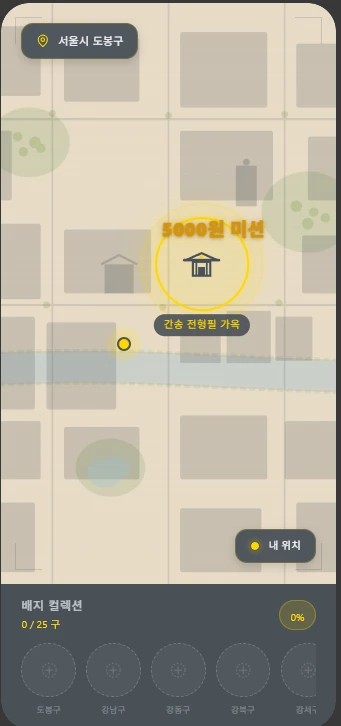
Visitors complete missions that require staying in a district for a defined period. Local businesses are the venues. The city issues a small guaranteed reward — a local currency redeemable only inside that district.The visitor gets discovery and reward, the business gets foot traffic, the city gets visitor-hours and economic data. The design makes the desired behaviour the easiest behaviour.
The economic engine loop
- Curiosity (Trigger) It starts with a mission, not a recommendation: “a story is waiting for you at this hidden spot.” This is the step aimed at the desire to discover.
- Proof of presence (Action) A quiz that only unlocks once you are physically there. It asks for more looking than a check-in would, and that looking is the first layer of time spent.
- Local currency (Reward) Completing it pays out a non-refundable local currency. The point is the restriction: it can only be spent nearby, so time spent turns directly into money spent at the shop next door.
- Writing the next quiz (Investment) People who have been there write the next quiz for it. The content accumulates for free, the author gains a stake in the neighbourhood, and the local knowledge becomes a moat that is hard to copy.
The full user journey
Prototype screens following a single place, the Gansong Jeon Hyeong-pil house in Dobong-gu, Seoul, from picking the mission on the map to spending the reward at a shop nearby and earning the badge. All four steps of the loop are in these six screens.
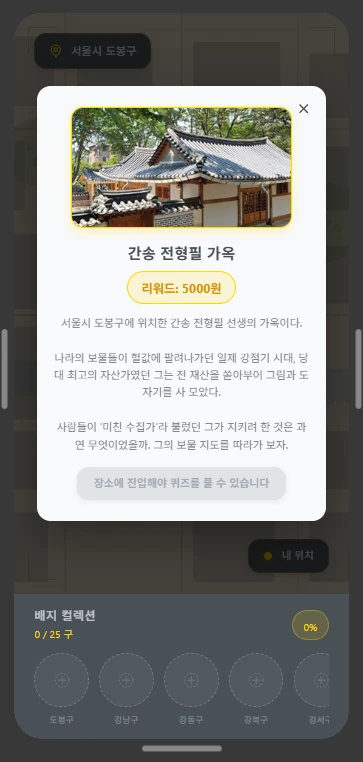
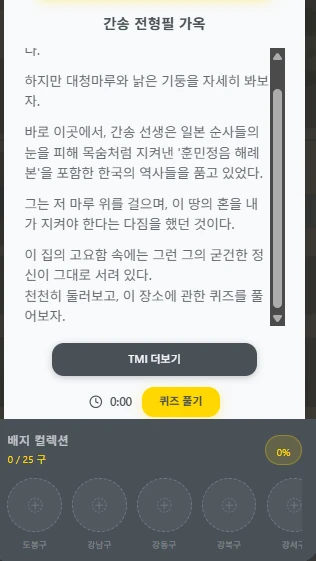
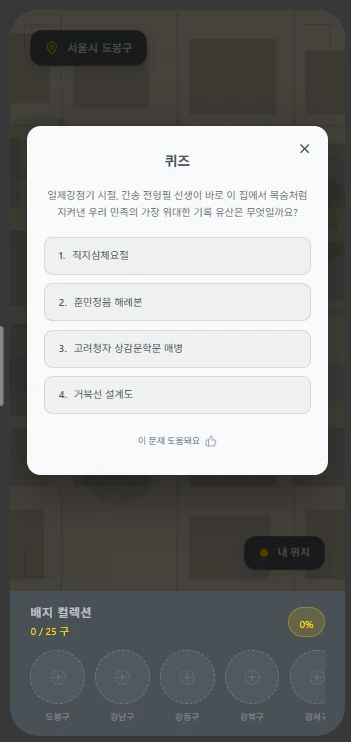
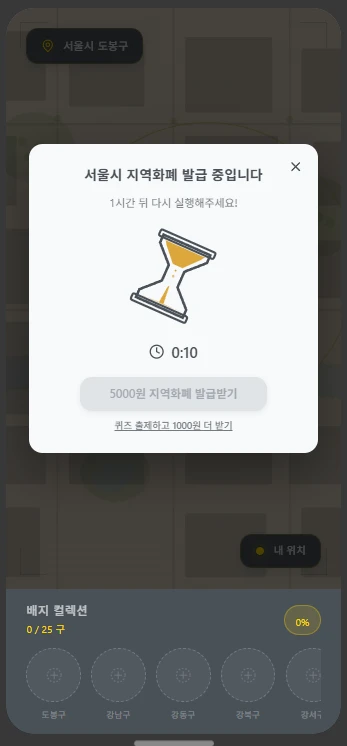
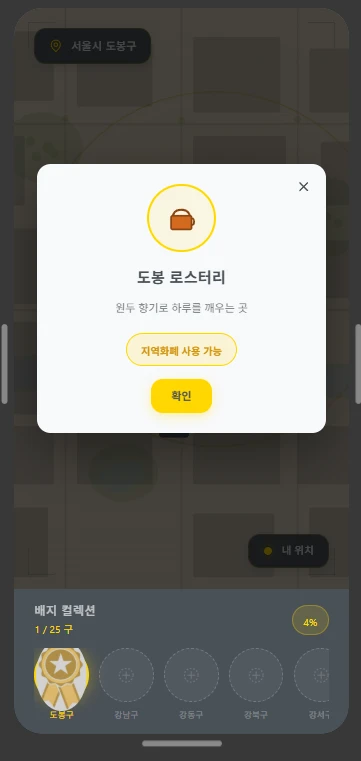
A prototype made before the validation test. Until the hypothesis below is tested, these screens are a proposal, not a result.
Not yet validated
The hypothesis is one sentence: “Will people willingly trade an hour of their time for a small, guaranteed local reward, triggered by a gamified discovery experience?” Confidence: about 55%. The behavioural logic is sound; execution is the open variable.The validation follows the same discipline as USFK-Pay — a no-code landing page, a fifteen-second simulated experience, a hyper-targeted campaign at residents of one Seoul district, and a go/no-go threshold of 10% set in advance. As of writing, that test has not been run, and the result will be published whether it is a green light or a kill signal.
The method that found one soldier’s identity problem is the method that found a city’s misaligned KPI. The unit of analysis changes; the discipline does not.