Social Computing · Product
Tremer
People predict trends not to be right, but to be the one who saw it first.
- Role
- Founder · product design · log analysis
- Period
- Nov 2025 – Present

The name is the hypothesis
Tremer comes from tremor — the micro-vibration a trend gives off before anyone calls it a trend. The claim is one sentence: a human gut catches that vibration before a scraper does.
So it did not start from trend analysis. It started from an impulse: everyone believes they have a feel for what is coming, and everyone wants to prove it. That impulse evaporates into conversations and feeds, and nobody has put a price on it.
The second hypothesis is narrower: the finder’s sense of ownership. People keep posting “1” and “this is about to blow up” in comment sections with nothing to gain. Nobody asks them to. It is a claim — I found this first — and underneath it sit self-efficacy and a wish to own something scarce. So the product question was never “how do we predict trends?” but “what do we give back to the person who saw it first?”
I tested the impulse with ads, before building
Before writing product code I compressed three competing motivations into three ad lines and ran them as a fake door — one form, different copy, separated by a URL parameter.
A · prove you are smart
“Your investment skill, proven with words.” Close to ten times the industry average.
C · get a real prize
“Invest in popular words, get real prizes.” The highest click rate of the three.
And then conversion collapsed to 2.47%. Buying a click is not the same as earning a person.
B · investing feels hard
“If investing is hard, start with words.” Less than half. A safe sandbox was not what they wanted.
Not fake investors — people who wanted to look smart
I was so taken with the idea of a “stock market for culture” that I missed the human motivation underneath it. My users did not want to be fake investors — they wanted to have fun and prove they were smart. So the points went away entirely and only the rank stayed. The reward is not money; it is the top of the leaderboard and the right to say so.
Three of the six that changed direction
Each pivot was not a feature fix. It was an admission that I had decomposed the desire wrongly, and a return to the start.
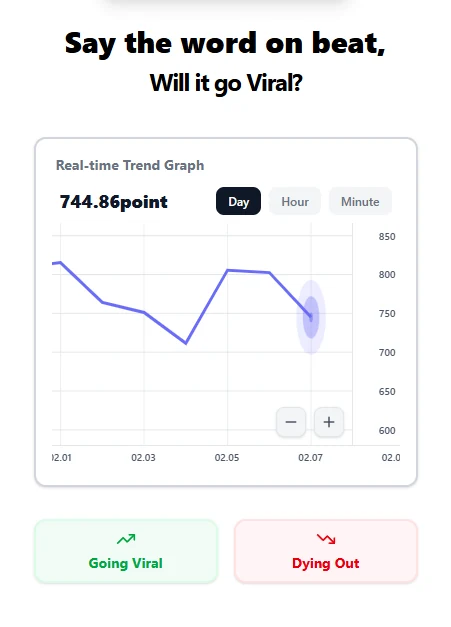
Users read a chart and predicted next week’s search volume. It took two-tenths of a second of thought, which in this era is an eternity.
It was homework dressed as entertainment. They did not want to predict through analysis; they wanted to feel they had foresight.
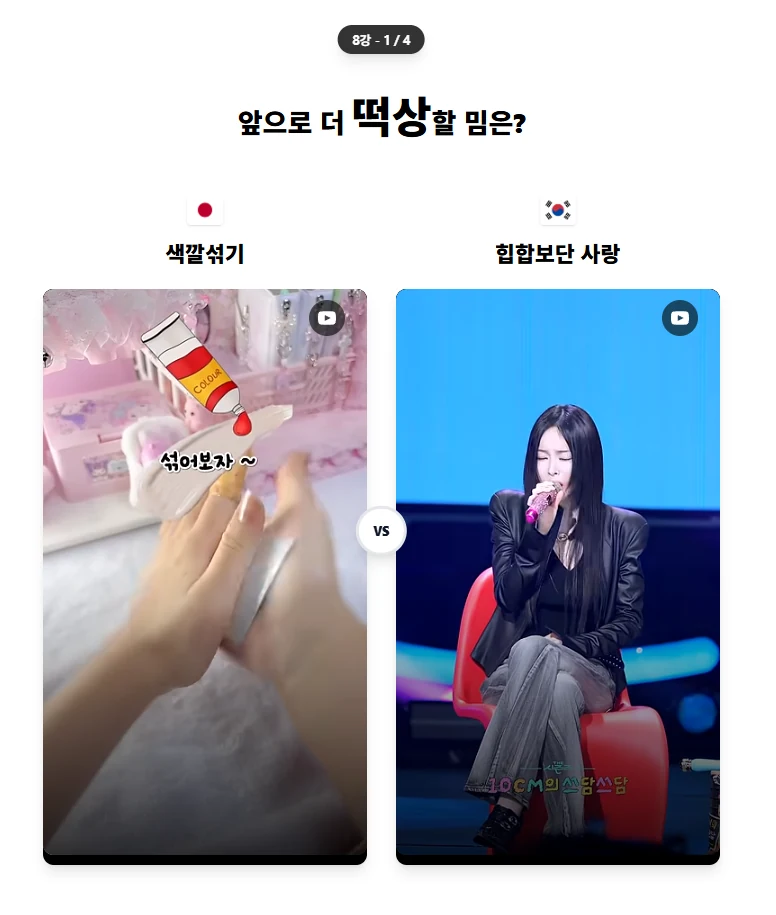
Charts out, two short videos side by side. Which one goes viral first? Decided in under a second.
Tremer was redesigned six times. What moved it was not my intuition but merchant interviews — the same gap kept surfacing between what users enjoyed and what businesses would pay for, and it eventually pushed the product to B2B.
The retraction
My early analysis reported that people lingered on the screen: a median of 38 seconds. It was a flattering number, which is exactly why it deserved suspicion. Digging back into the logs surfaced the cause — background timeouts. Time spent with the app backgrounded was being counted as dwell time.
Time spent with the app in the background was being counted as dwell.
Reported 38.0s → re-analysed 1.5s. This single fault contaminated six reported metrics. All of them were retracted and the analysis was re-run.
Cross the threshold yourself
The ten seconds came out of the logs, but to a reader it is just a number. So it runs here instead — this is how long you have stayed with this block.
This is counted in your browser only — nothing is sent or stored. This project retracted six metrics over a measurement artifact, so the measuring done here holds to the same standard.
What survived re-analysis
A 10-second engagement threshold
Across logs from 2,013 devices, sessions that crossed ten seconds behaved distinctly differently from those that dropped before it.
Browsing and sign-up ran in reverse
It was not that heavy browsing led to sign-up; signing up led to heavier browsing. I had been reading the funnel backwards.
Shipped screens
The fun of a game collects the data; the authority of a finance terminal hands it back.

The better a number looks, the earlier it deserves suspicion. Killing your own finding is part of the work.